Sunday, March 13, 2011

Chronic Review: Infestation GI Joe # 1!


Infestation: GI Joe # 1
IDW
Script:     Mike Raicht
Pencils:   Giovanni Timpano
22 pages for $3.99 (although probably more for the incentive cover pictured)


I did something really stupid and ordered this book without ordering the opening Infestation chapter by Abnett & Lanning.  I'm not sure why anybody would order the one without ordering the other, because the first chapter contains vital, need to know information about what actually constitutes the infestation, which seems, in the grand scheme of things, fairly important.

There's an opening paragraph that explains that there's a zombie hive mind that infected a vampire named Britt, who decided to share this infection with as many worlds as possible.  Somehow this infection is spread both magically and technologically.  Having read both the GI Joe and Ghostbusters Infestation books, I can tell you that this infestation acts entirely different between the two.  Like, no apparent way they could be the same thing.  Does any of this make sense?  Probably not.

Here's what I do know - The Baroness and a team of Eels are interested in a tiny sailboat carrying three Joes and absolutely no technology.  Their thinking is that if the Joes were to secretly transport something big, they'd protect it with a well-armed ostentatious convoy.  But if they wanted to skulk around with something really important...they'd transport it without a whisper or a footprint.  So whatever is in this sailboat must be of paramount importance.
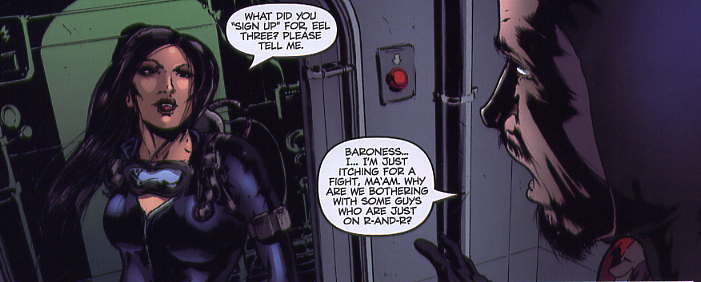
Things do not go well for this guy.  Trust me.

Turns out that the Joes are in fact carrying a global level threat on that sailboat - a severed arm infected with Britt's bug.  If it gets any where near tech, it takes it over, determines its attack capabilities, and then opens up on everything with extreme prejudice.  So if this arm gets hold of something like say...a Cobra or GI Joe database?  That could be a problem.

So the threat in play is suitably large, which creates tension, and that's all well and good.  You could say it's "half the battle" if you were an asshole.  And I am.  The juice is always in the characters, though, and the good news is that Mike Raicht made sure that to pepper the bigger picture with delicious little character bits.

My safety word will be-- ahh, screw it, I don't need a safety word
Baroness is an iron-plated stone cold psycho bitch, and I think I love her.  Some women overcompensate because they're trying to swim in a "man's" world.  They're simply protecting a gooey center in a harsh environment to survive.  That works.  Baroness is a dangerous, heartless witch in this comic.  That's just infinitely more satisfying.  I want her to punish me.

She's got two worthy opponents in the comic: Psych Out and that severed arm.  You wouldn't think a removed limb could really cause that much trouble.  Well this lonely appendage just needs a wheelchair-bound scientist, some faulty robots, and a pack of pissed off experimental lab animals to tip the whole planet on edge.  This is a lump of flesh going places, my friend.


I'm not convinced that this story works particularly well as a seamless crossover entry.  But as a stand alone story with some drama and punch?  It does kick a healthy sum of ass.  But I'm kind of a sucker for this kind of trope, mind you.  I love it when a small band of misanthropes are in way over their head and somehow need to not only survive, but find a way to neutralize the threat so that the whole world isn't flushed.  If you're like me and you dig stuff like Carpenters Thing, or Tales From the Crypt: Demon Knight - this is perfect.

- Ryan

Saturday, March 12, 2011

Chronic Review: 5 Ronin # 1 & # 2!


Five Ronin # 1:  Wolverine
Marvel Comics
Script:     Peter Milligan
Pencils:   Tomm Coker
22 pages for $2.99

I was cautiously optimistic about the hook for this series - Marvel hero concepts injected into 17th century Japan.  This isn't a time travel story, mind you.  If you're expecting to find the 616 Logan dropped into a period piece, you guessed wrong.  This is the story of an unnamed ronin that has nothing whatever to do with what Jason Aaron is doing right now.  Kind of like every other Wolverine story Marvel is currently doing.  But I digress.

It's actually hard to talk about the story without spoiling it entirely, since it's purely plot based.  And it's a little weak.  I didn't even understand what had actually transpired the first time I read it.  On the second pass, I get it.  But it's a little weak. It's weak because I believe the story was built backwards.

I think I can best explain with an adorable train wreck known as M. Night Shyamalan.  Now, Shyamalan is a talented bastard, and that's just a scientific fact.  He is of course best known for Sixth Sense and the unbelievable "O Henry" style button-hook he planted on everybody.  If you say you knew what was coming at the end of Sixth Sense, you are a liar.  You are a liar, and I'm done talking to you.  But I digress.

The point is that Sixth Sense's stunningly successful twist ultimately doomed him, because he kept trying to repeat it.  And when you start writing stories backwards from a twist instead of forward from real characters with compelling motivations than your story (usually) becomes an unsatisfying trick.

Friends don't let friends write The Village
Shyamalan broke type for his best (in my opinion) film, Signs.  Signs was not about a trick ending, and it surely was not about "little green men".  I often hear detractors spout some nonsense about how they couldn't tolerate Signs because of the ridiculous alien elements.  Watch the movie again with your brain in and your eyes on.

Signs is not about little green men from outer space.  Signs is chiefly about the validity of faith in an age of postmodernism.  The results are subjective on that, of course, but I think it fails there.  It's also about how we gain strength from accepting the weaknesses in ourselves and others, and on that count I think Signs succeeds wildly. That family is one step ahead of things because they accept the dorky conclusions of Morgan, whose bum lungs save him from the poison gas as well.  The day is saved when Merill's overkill swing that cost him his baseball career knocks water onto the alien.  Water that is only available because they allow Bo to leave 13 full drinking glasses around the house instead of making her use one at a time like a sane human.  It's genius, frankly.  And the story works because it's built on themes and characters.

Then you watch The Village and you realize that you just flushed 90 minutes of your life on a story that makes absolutely no goddamn sense on any planet.  The whole thing is an exercise in trickery, designed solely with the intent to deceive the audience into false conclusions.  "Ha ha, you didn't see that one coming, did you?"  No sir, I did not, because in retrospect, none of what you've shown has any connection to logic at all.  That doesn't make you a good writer, that makes you an asshole.  That's what happens when you work backwards from a gimmick.

This has all been a very long-winded way of saying that Milligan has a bit of a pickle when writing these stories.  The conceit is that he has to find a way to suggest the super attributes of these Marvel characters while attempting to steadfastly stick with the realities of 17 century Japan, where there are no mutants or Weapon X programs.

 The result in Five Ronin # 1 is that instead of writing a story about themes and characters, Milligan provides us with a "plausible" explanation for Wolverine's regenerative capabilities.  Because it's built backwards from that conceit instead of forward from characters and situations that Milligan might actually care about, the whole thing feels flat and convoluted.

Oh, we get our explanation, eventually.  And after reading it twice, I guess it technically makes sense.  But there's no real reason to care about any of it, the motivations are weak, and nobody says or does anything particularly interesting along the way. 

There's a drunkard force-fed into the mix as well, I believe it's going to be 5 Ronin's Deadpool, and I believe that this character also appears as the "cowardly ronin" in the second issue of the series.  I'm guessing this is an attempt by Milligan to thread these stories together and eventually dovetail them a la Guy Ritchie - but again, now we're talking parlor tricks again, and not pure storytelling.  Speaking of issue # 2...

Five Ronin # 2:  Hulk
Marvel Comics
Script:     Peter Milligan
Pencils:   Dalibor Talajic
22 pages for $2.99


The Hulk Ronin story is a much more straightforward retelling of High Plains Drifter.  In this case Hulk plays the role of Clint Eastwood, and instead of saving the townsfolk from the nasty bandits by painting the town red, he has them dig a couple of fire pits.

There's nothing wrong with that, I guess, and in point of fact I enjoyed this issue far more than the preceding Wolverine effort.  High Plains Drifter is just a variation of the Shane legend, where a highly skilled gunfighter suffers a personal tragedy and lays down his guns, picking them up again in defense of lesser folks in need.  The villagers originally try to hire the character I believe will be revealed as Deadpool, but he refuses to fight when he sees the numbers stacked against him.  So "Plan B" is to send him up the mountain to find Hulk.  The cowardly Ronin gets his attention by slamming an arrow off his skull.  That sounds like Wade, doesn't it?

There's a little more characterization in this second issue, for the bit players and the monk who would be Hulk.  There's also a whole lot less confusion, and the pacing feels much brisker.  I think it makes more sense than the first issue, thematically and in structure.  But it surely didn't wow me in any way.

Five Ronin does not constitute bad comics.  I thought the art was very nice in both books, and there is some payoff with the premise.  If you're interested in seeing some Marvel archetypes interact with old samurai culture, I can see a person getting a kick out of that.  Attention has been paid to the historical setting, which is fun, and the parallels between these Japanese characters and their modern counterparts are clear but subtle.  Neither of these stories really pop in and of themselves, though.

Of course the problem in making predictions on the rest of the series is that these are basically stand alone stories, and the successes and failures of the first two issues won't necessarily translate to the others.  For all I know, the next three could all be Eisner nominated productions.  My guess is that they won't be.

I think Five Ronin represents a solid hook executed in an acceptably professional but imminently forgettable way.  I think if you're really interested in seeing Marvel characters in an anachronistic setting, you should run not walk to your LCS and find a copy of Neil Gaiman's 1602.  And if you want to see Peter Milligan flex his best writing muscles, go find his Shade, The Changing Man trades at the same comic shop.  Those are delicious!

- Ryan

Friday, February 18, 2011

Market Spotlight: Green Lantern # 30!


Here's the short of it - there's something in this issue important enough to "War of the Green Lanterns" that DC has decided to reprint GL # 30 in the FCBD Green Lantern/Flashpoint book.  That probably means buzz, which means more people interested in it than have it, and well....you know the rest.

But then again, maybe a reprint kills the action.  There was a day when I would have poo-pooed the notion, partly because the market used to really prize first prints in a way that it doesn't currently, and partly because I like saying poo.

I guess what I'm saying is that the issue is more complicated than it used to be.  I like this as a play because basically everything from Green Lantern # 21 on up has some heat behind it, and this news, when it finally sinks in for folks, really ought to bring more heat.  A book like Green Lantern # 37 is pretty easy to sell for $15+ right now, and there are several other issues in the current Johns run that are not that easy to find and quite desirable as people climb on board and want to complete their run.

This brings a couple of points to mind.  Firstly, comics are relatively scarce right now.  The myth is that old comics are scarce and everybody has 30 bagged copies of everything new, so there's no market for it.  The truth is that old comics in top condition are scarce, and nobody has 30 bagged copies of anything any more.  The direct market is just in a scary place right now, and the comics being printed today are printed in smaller quantities than they ever have been.  So when interest is piqued, it isn't hard to have more people looking for comics than can find them.

More importantly, though, it's worthwhile to observe what a remarkable thing Geoff Johns has done with the Green Lantern franchise.  I've often declared that the only book to avoid attrition is Kirkman's Walking Dead, and that's almost true.  Green Lantern is a much stronger piece of the DC lineup than it was five years ago.  Johns built that brick by brick with solid storytelling, and he has maintained that elevated status far past the initial surge of the Sinestro Corps War.

Bottom line?  I don't think it prudent to back up the truck on this, assuming you could even score a truckload of these if you wanted them.  But I think it's a good idea to tuck one or two away if you can find them at $5 or less, and that's still possible as I type this.

- Ryan

Thursday, February 17, 2011

Chronic Review: Silver Surfer # 1!


Silver Surfer # 1 of 5
Marvel Comics
Script:     Grek Pak
Pencils:   Steven Segovia
22 pages for $2.99

Let's face facts - Silver Surfer is a great high concept, because he can do almost anything, go almost anywhere, and the stakes can go higher for that character than almost anybody else.  When the cosmos is going to crack in half - you can bet the Surfer is going to be nearby, loaded for Ursa Major.  Plus, he's got a real good look, does the Surfer.  My favorite comic book cover of all time?  That would be Silver Surfer # 4, by the incomparable John Buscema.

But he's boring.  Yeah, I said it.  You know it, and I said it.  Norrin Radd is dull.  He's too virtuous, he has no sense of humor, and he never appears to have any motivation or plans of his own.  You know what Somminex is? You take the pill and Norrin Radd whines at you about Shalla Bal and his unfair lot in life - clunk! - out like a light, commence with the snoring.

And in this new five issue mini-series by Grek Pak and Steven Segovia, Norrin Radd is still really goddamn boring.  The closest thing we have to personality is Surfer letting sand slip between his fingers and observing that it never sticks.  God, he must kill at parties!

But there are some things I rather liked about this comic, and here they are in no particular order:

Galactus Is Not A Villain, He's Just Top Of The Food Chain


OK, maybe that's not an unprecedented concept, but I like that treatment of the big purple headed warrior.  Listen, nature is a giant dick.  Things kill and eat other things to survive.  It aint pretty, but it's how the game is rigged.  You know what the best thing for a forest is?  It needs to burn down randomly every couple of centuries, so that the new growth can profit from the ashes of its parents.  If you want some healthy growth somewhere, something else generally has to die an excruciating death. 

That's all Galactus is.  He's the excruciating death part of this nutritious breakfast.  That's a lot more interesting to me than a selfish prick on a power trip with a really big hat.

The Power Cosmic:  Really Good Crack Without Side Effects


Usually the power cosmic is depicted as nothing more than really big laser blasts, which is total bullshit.  The Silver Surfer is tied more directly into the fabric of reality than other people.  He's got access to a lot more latent energy, and has far more direct control of it.

I tend to think of "God" as everything, the only thing.  The implications of the power cosmic to me are that Norrin Radd got something akin to a direct line to God.  Being around that power could easily be construed as a religious experience, if you will.

And that's pretty much how Pak is approaching Surfer in this installment, although he attaches no overt religious connotations, which is just as well.  Being that close to a pure universal energy produces a kind of narcotic reaction in Carla, which I thought was outstanding.

It's the little things that count, as always.  Paying attention to the way his powers work tells me that Greg Pak is not just mailing this in, he's exploring the implications of things, and that's fun for me.  It's also interesting to me that Norrin doesn't experience that bliss at all.  You can acclimate to anything if you're swimming in it all the time.  I think Pak is implying that Silver Surfer is a dead fish of a character because once you've gotten used to pure joy, what's left outside of apathy?

But how do you fix that and make the character interesting, then?

You Take Away His Power Cosmic

Pretty simple, huh?  It certainly makes him more vulnerable, the threats become more real, the personal stakes get higher.  Hell, we might even get to see a version of Norrin Radd that doesn't instantly produce a nap!

I don't know if any of that will happen, but I like the fact that Pak is going to give us a chance to see Norrin come out of his shell, literally.  I like the fact that Steven Segovia is on this book, because he makes it look good.  All of it.

It's not all perfect notes, of course.  I really don't like the whole naval-gazing Silver Surfer stumbles onto a situation while sitting idly routine.  Just once I'd like to see this character with an agenda, instead of playing the wandering little bitch.  I don't care a white about Angel, Carla, or any of that nonsense.  I don't find it particularly likely that the High Evolutionary could just show up instantly with the tools to neutralize the Silver Surfer.  How could he possibly have the tools to do that without a similar subject to study?  It would seem to me that he would be a tough nut to crack.  I know, I know, it's comics.

So yeah, there are problems.  Hell, I think I know how this ends already.  I think it's going to book end itself.  The story begins with Silver Surfer bailing out his old boss with a little star energy.  I'm guessing Galactus pays it forward at the end of the story and helps him back.

But whatever.  The point is that in the interim, Pak has set this thing up with at least the possibility that Norrin Radd might do something interesting, and that is a feat of cosmic proportions.

- Ryan

Wednesday, February 16, 2011

Chronic Review: Marvel Girl # 1!


Marvel Girl # 1 (one-shot)
Marvel Comics
Script:    Josh Fialkov
Pencils:  Nuno Plati
22 pages for $2.99

The new Marvel Girl one-shot is a kind of origin story embellishment set in the X-Men: First Class end of the universe.  The capsule situation is this:  Jean is frazzled.  The boys at Xavier's are fighting over her or clinging to her, and she lets loose with her powers in a dangerous little fit of exasperation.  Xavier scolds her a bit before sending her packing from the school until she gets her act together again.

Back home, mom and dad are a welcome sight until they get over-emotional about the whole deal and Jean runs off to the mall to decompress again.  Once there she discovers that everything is just like she left it...in fact, far too much like she left it.  Everyone she used to hang out with at the mall is still there, doing the same things, stagnant and arrested in development.  The source of this weirdness appears to be the ghost of Jean's best friend Annie.

Fialkov's wheelhouse appears to be psychological drama and subtle weirdness, and this book has both elements.  Unlike his stellar work on Echoes, however, Marvel Girl falls incredibly flat.

The moral of the story is about moving on and growing out of the past, and losing a close friend for any reason is a powerful catalyst.  Perhaps it's because Fialkov is constrained by his X-Men: First Class audience, or perhaps it's because he's constrained by getting the whole story told in 22 pages, but this particular tale feels like a geared down shortcut to a much better story.

Given more space to breathe, I think the full ramifications of Annie's "curse" would have made more sense and felt more threatening.  And if we had more time to actually care about Annie and Jean's relationship, the loss would feel more profound.  As it stands, Marvel Girl # 1 reads like an X-Files after school special.

The art by Nuno Plati seems to be very anime inspired, which will often chafe me. In this case I found it mostly tolerable, although the characters look awfully thin.  The ghosts of the past are represented in bright pink hues, which worked for me, and might not work for everybody.  I'm thinking that the book is aimed at a younger audience steeped in modern animation, and I'm guessing that group will feel right at home here.  The cover by Roger Cruz is absolutely gorgeous.

Ultimately, there isn't enough emotional punch or character insight between these covers to justify it for me, but I think I might be demanding the book be more sophisticated than it intends to be.  I would have like to have seen what Fialkov could have done here with 4-6 issues while shooting for a more adult audience.  But that's just me wishing it could be something it's not, which is probably unfair. 

- Ryan

Thursday, February 10, 2011

Chronic Tribute: Steve Gerber! (9/20/47 - 2/10/08)


Steve Gerber was a unique creative force.  He was imagination with impeccable steering and really bad brakes.  His stuff was weird, and not for everybody.  Steve Gerber was not for squares, back when there were such things as squares.

I think the real genius of Gerber's writing was that it was pure.  He didn't turn the Defenders into a wonderfully dysfunctional non-team to wow you with eccentricity.  He didn't pair Daredevil up with Moondragon and send the guy into space so he could buck trends or generate buzz.  He didn't create a national sensation in the form of an extra-dimensional duck with aspirations for the oval office to reinvent the genre.

Steve Gerber did not melt your mind as an attack.   It was simply the natural byproduct of his mental mutancy - he was a fully functioning, rational adult who never developed an anti-fun filter.  Children don't filter anything, their imaginations run free and unchecked.  We beat it out of them fairly quickly with fascist group thinking and a focus purely on "results".  The idea is never the thing as we pass from childhood to adolescence to bitterness.  What can you do with it?

I think Steve Gerber was a one-in-a-million treasure who never let that damned filter kill his flow.  (We got our lottery winner in this generation in the form of Grant Morrison)  He let the ideas flow and then asked a better question than everybody around him:

Why not?

He'll probably be best remembered for Howard The Duck, followed by Man-Thing and The Defenders.  Those are all fine things to remember Steve Gerber by.  The thing that sticks with me more than anything, the thing that defines Gerber's contribution to the comics medium is that throw-away series form Malibu's Ultraverse called The Exiles.

Tom Mason and co. handed Gerber a team full of cliches, and he created one of the great button-hooks in the history of comics.  It was going to be the usual comics fare - a super scientist discovers a fatal "Theta Virus" that also generates super powers, and Dr. Deming forms a team of jag-offs and miscreants to serve the greater good.

In comics, hell, in storytelling, the rule is you slap these ill-fitting pieces together, and it isn't always pretty, but by gum that team is going to learn from their mistakes and each other and prevail in the end.

Not in Gerbertown, baby.  Sometimes when you chuck a bunch of ill-fitting pieces together the machine falls apart.  And that's exactly what The Exiles did - they failed spectacularly.  Nobody knew what the fuck they were doing, catastrophic mistakes were made, Amber Hunt literally blew up and took most of her teammates with her.

In life outside of stories, things fall apart.  The center cannot hold.  This is NOT the way you write comic books.  The idea of an ongoing series is to keep going on.  Gerber flushed the whole works in four issues, and the payoff was extraordinary.

There were some ruffled feathers over the fact that Malibu solicited an issue # 5 that it knew would never be published. (retailers were reimbursed, of course, but it felt like dirty pool) The only way the story works, of course, is if you hold the stodgy old pattern in your head (it's an ongoing series, nothing really bad can happen) only to have your mind blown when the entire team is laying in pieces due to gross incompetence.


Why not?

We miss you, Steve Gerber!
- Ryan

Wednesday, February 9, 2011

Chronic Insomnia Rapid Fire Reviews!


(Powers Boothe not included)

Roundhouse kicking it off with:

Power Man & Iron Fist # 1
Marvel Comics
Script:      Fred Van Lente
Pencils:    Wellington Alves
22 pages for $2.99

Many mixed feelings on this book, although the more I ponder, the more I'm leaning toward labeling it pure garbage.

Iron Fist is still Danny Rand, who still plays it straight.  He now plays mentor to a new Power Man, Victor Alvarez, filling the role of the gregarious minority character in this edition.  Sweet Christmas, but Alvarez is annoying, almost exclusively so.  I suppose that's Van Lente's intentions, so perhaps it's a good thing that I can't stand this kid?

Aside from the prototypical brashness and naive "black and white" moral foundation, there's little to Alvarez.  Luke always seemed charming to me, even when he was being a dick.  It may not be a good idea to hold Victor up to Luke's standard, but when you name the book "Power Man & Iron Fist", the comparison begs itself.  I do not find the current version of Power Man charming in any way.

Perhaps it's the barrage of objections to the word "Master", or the Spike Lee "40 acres and a mule schtick".  I get it.  Danny's a white guy, Victor is not.  This is not new ground, and these lines are not insightful, or challenging, or cathartic.  They offer nothing healing or clever.  I imagine that material is in there with the idea that these things are wildly funny or "hot button".  It's all been done before in less irritating fashion.

I'm mildly interested in the sub-plot involving old school Heroes For Hire manager Jennie Royce.  She's (probably?) been framed for murder, and jaded Danny wants to help but isn't completely sure that his old friend is as innocent as she professes.  If that doesn't sum up the 21st Century, I don't know what does.

Power-Man, being the cock sure spitfire that he is breaks into Crime Buster's apartment to start working on the case illegally before Iron Fist has even decided he's going to get involved.  That's when the "masked stereotype" A plot busts into the B plot, and Victor is left to fend for himself against the whole lot since he ran off on his own.

I think the story can be salvaged, and it's not all terrible.  It's briskly plotted, and it was constructed in such a way that you don't need to have read the previous 125 issues of PMIF or the Shadowland: Power Man mini to function.  I think if you find Victor engaging you'll find the book engaging, but I find myself pining for Christopher Priest, who would handle these characters with more a more deft touch.

Osborn # 3
Marvel Comics
Script:    Kelly Sue DeConnick
Pencils:  Emma Rios
22 pages for $3.99

I have no mixed feelings about Osborn:  this is a delight on every count.  It's the little things, you see.  Writing Osborn is not easy.  At least, it isn't easy to write him correctly.  The problem with Osborn is that he's a genius, he's crazy, and he's charismatic.  It's easy to screw any or all of that up. The trap is to simply write gobbledygook in place of incisive wit, gobbledygook in place of true dementia. And how do you portray a voice that commands greater men?  (writers have similar problems writing Captain America, who often spouts empty stoic nonsense instead of commanding respect)

So why do others follow Osborn, fall into his trap?  He's got political and physical power, sure,and wealth, too.  But he's not off the charts in any of those categories - how does a guy like that take over The Initiative?  Deconnick explains it, in a wonderful soliloquy by Sen. Sondra Muffoletto, and then demonstrates it in a prison fight.  You want to know why Osborn is Osborn?  It's in this comic.

And she does it all seamlessly, without calling undue attention to any of her craft, letting you enjoy the narrative flow.  There are no bit characters in this book, everybody lives and breathes.  Everybody has their own voice, and their own motivations. This is the hard stuff made to look very easy, it's very rare, and that ladies and gentlemen, is Kelly Sue DeConnick.

I have not been in love with the pencils of Emma Rios up to this point, but I'm sold now.  There are framing shots and action shots in this comic that just dropped my jaw.  There is nothing to not like about Osborn other than the cover price of $3.99.

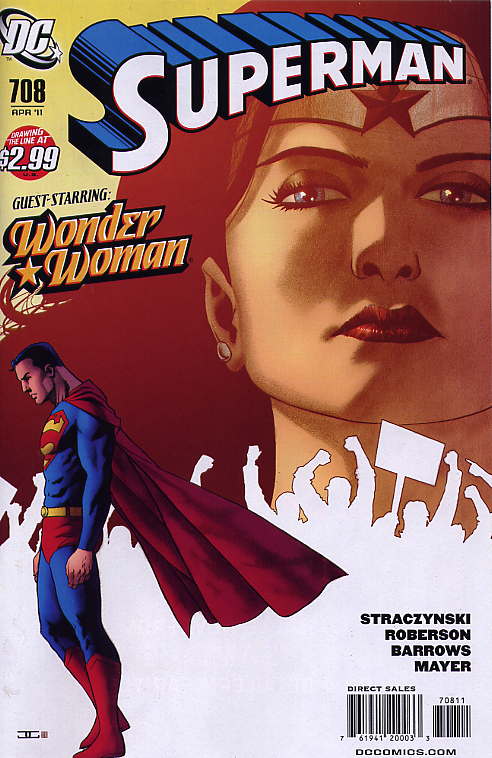
Superman # 708
DC Comics
Script:     Chris Roberson (and JM Straczynski?)
Pencils:   Eddie Barrows
20 pages + 5 Batman & Robin preview pages for $2.99


I don't know if this is the best comic on the stands.  Matter of fact, I know that it's not.  I do know that it is infinitely entertaining to watch Chris Roberson try to extricate himself from Straczynski's foundation in the most passive aggressive manner possible.

Does Roberson see it that way?  I don't know.  It seems like he's intentionally taking a literary dump on Straczynski's lunch.  What he's done is take the painfully earnest and bizarre "Grounded" Superman and explain it away as a cocktail of post-traumatic stress disorder combined with a dash of depression and a splash of super-villainess mind control.

The implied message goes like this:

"There's no way I can take any of Straczynski's work seriously, much less continue with it.  My only option is to paint what's gone before as the demented ramblings of a psychological victim."


And that is awesome.  He even brings in Wonder Woman as if to say "Yes, JMS ruined her, too.  Let me bring her back to normalcy as well and have a heroic Superman inspire into some form of normalcy."

Straczynski's name is still on the cover of this thing!  There's just no way this is what he had in mind.

The down side I guess is that after two issues, this still isn't really Roberson's book, it's still in the process of becoming "Not Straczynski's Book".  It's kind of weird that Clark just threatened Lois and just dropped the issue so that he could follow some Super People down the yellow brick road.  That group didn't really blow me away, I'm not feeling Superman's brain washing nemesis as a visceral threat yet, and Wonder Woman is in the same odd unidentifiable place that the title character is in.  The whole thing feels like a sputtering junker that Roberson is desperately trying to keep running, praying it makes it to the shop before it dies.

It's fairly awesome to watch it sputter, though, for now.  When do we get to the new good stuff?

- Ryan