Thursday, September 30, 2010

Chronic Review: Terminator 1984 # 1!

Terminator 1984 # 1 (of 3?)
Dark Horse Comics

Script: Zack Whedon
Pencils: Andy MacDonald
24 pages for $3.50

It's very easy to screw up licensed books, because they are a double edged sword. On the one hand, you have a pre-baked audience clawing to get at any material related to their particular fetish. On the other hand, said pre-baked audience is often neurotically obsessed with any number of arbitrary elements of said fetish. Screw up Luke Skywalker's boots and see what happens. Someone will have a coronary.

Sometimes licensed properties try to stray a few paces away from the pure source for that reason. If you just get within shouting distance, you can still generally attract the attention of your base, without risking as much sacrilege. I think the Star Wars books fall under that category, currently. Maybe Dark Horse isn't publishing Luke & Han stories because it's all been done before. Who knows? I prefer the Buffy Season 8 formula, that dives right in and picks right up where the series left off. Terminator 1984 is the Buffy type of series.

The first issue happens during and after the 1984 Terminator film. You get to see some supplementary action with Reese, Sarah, and Cyberdyne as movie events unfold. You get to see some other stuff happening concurrently with a new character, Ben. He's a friend of Reese, apparently sent as backup that Reese never counted on. (Maybe I'd know more about the situation if I'd read Terminator: 2029, but I did not)

The fun thing about Ben is looking at our world through his eyes. When I look at the Dog & Pony show we've created with WAY too many goddamn people, I get depressed. Ben came from a place where machines have gutted everything, including most of the people. He thinks human excess is delightful. It's a refreshing take, actually.

Zack Whedon is pretty hip to what we want to see in a post-movie story:
  • What happens to Reese?
  • What happens to Sarah?
  • What happens to the Terminator?
  • What the heck is Cyberdyne up to?
This is not trigonometry, mind you, but sometimes this stuff does get screwed up. Thank you, Mr. Whedon, for not trying to get too cute with things. There's nothing wrong with giving the people what they want, provided there are a few surprises along the way, and the execution is professional. I see no cause for alarm on any counts for this comic.

Kyle Reese is still alive. He's still alive, and his friend Ben from the future is coming for him. Cyberdyne has Reese,has the T-800, and has the will to be a bunch of Machiavellian douche bags. Ben knows he can't complete his mission solo, so he tracks down Sarah Connor so they can go create mischief together. This is very solid, no-nonsense, action oriented plotting that really should satisfy anybody interested in that first movie.

My only concern story-wise is that as issue # 1 ends, we're looking at a Terminator story with no functioning Terminator. Now that could change very quickly, because if Ben made it back to 1984, there's no reason others couldn't as well. I'm not panicking. Frankly, if this series just deals with Ben & Sarah getting Reese back from Cyberdyne, that would be enough for me. But I wouldn't mind if another Terminator got loosed, either. Not one bit.

I'm a little confused about how many issues of this we can expect. There's nothing on the cover to indicate whether this is intended to be an ongoing or a mini-series. I looked up the title on the Lone Star Comics site, and issue # 2 seems to have been solicited as the second part of a three issue mini. No mention of this in the solicitation copy of issues #1 and # 3, however. Terminator 2029 was a three issue mini, but that doesn't necessarily mean anything.

In a different era, I think this would have made for an outstanding ongoing. Creatively speaking, it could still make for an outstanding ongoing. I have a soft spot in my heart for that original film, and this comic caters well to that soft spot. As long as this comic gets published with this quality, I think I'm on board.

Unfortunately, I'm going to put the over/under at 10,000 for orders on this book. I hope I'm off by about 20,000 copies and this thing gets a chance, but that really isn't how 2010 operates. The last mini-series launched at around 10,500, this one should probably do something similar.

Here's the scary part. Think about how many Terminator fans there are out there for a moment. Let's put it absurdly, impossibly low and say there's one million. Worldwide, that one million figure is absolutely laughable. And granted, not every single Terminator fan would be interested in reading the comics.

But if this book sells 10,000 copies, that's only 1% of my ridiculously conservative fan figure. Dark Horse is reaching less than 1% of its built-in fan base. The problem is three fold:

  • People don't know that comics are still published
  • People who know that comics exist don't know that Terminator is available
  • People who know that Terminator is available don't know how directly related it is to the original film, and that it's pretty darned good.
That's a lot to overcome. And just to be clear, I don't have my angry pants on regarding Dark Horse and their ability to get the word out. Maybe I should? My assumption is that if there were an easy answer, Dark Horse would be doing it. I think they genuinely would like to sell some Terminator comic books.

But it's scary how little sway we seem to have, how quiet our voice is. A fraction of a tiny fraction of Terminator fans seem to know or care that this comic is on the stands. It might be less than a tenth of a percent. And that's scary.

Just as a comic book, the first issue was good+ and not great. Very clean storytelling, where the characters, actions, and motivations are all clear. If you're a Terminator fan, I really think this is hitting you where you live. I'm really curious to know what a fan like Leroy Rivera of Comic Tube thinks of this, because it was pretty much born to serve him. For my money, Zack Whedon is covering all the bases, and with some skill.

- Ryan

What's Shakin'?


Did you listen to Chronic Insomnia episode # 160 and wonder what the hell a Shake Weight is? Well now you can join in on the fun!

- Ryan

Monday, September 27, 2010

What Makes Ryan Bleed?

Is Ryan going to leave Chronic Insomnia and become a writer for Bleeding Cool? Probably not, but I can tell you one thing, he's going to kick it old school in this excellent interview by CI fan Mike McLarty.

Some of you see what he does each month as selling his trade paperback soul to the free market, but after reading this interview you'll see he poops sitting down just like the rest of us, he just makes more money doing it. (if that makes sense at all).

Check out the interview here and feel free to check him out live each week on Chronic Insomnia.

-Michael

Sunday, September 26, 2010

Crazy Enough To Work?

You're lying to yourself if you weren't excited by the prospect of Marvel's New Universe in 1986. Go ahead and fool yourself if it helps you sleep at night, but I know better. That lighting banner was exciting shit, made all the more exciting by the fact that there was no internet and no Previews solicitation copy spoiling everything. Marvel was fully dominant, often grabbing 75% share, and it looked like they were about to change everything.

Urban legends rage about what exactly the New Universe was supposed to be and how much change was actually on the table. Doug Moench and a lot of the Old Guard swear that Jim Shooter's plan for Marvel's 25th anniversary was to scrap everything and run with new characters. Spider-Man, Hulk, Fantastic Four, Avengers? All gone. Everything concluded, with an assload of new #1s with new characters the next month. That would have taken balls so large they would maintain their own gravity.

There's some circumstantial evidence for this. Jim Shooter lost his editor-in-chief position because a good chunk of the veteran editorial leadership conducted a palace coup and said "The man is crazy, and either he goes or we all go." Shooter soon went. Only a few principal folks really know what was said in that meeting with the Marvel top brass. But if Shooter really was planning on chucking 25 years of history and running with a catalog of unknown commodities...you'd think that would get somebody's attention.

Jim Shooter claims he never planned anything of the sort. His official position on the subject is that he proposed two game plans for the 25th anniversary. A) Re-boot all the existing characters, and begin with new # 1s, sort of like a line-wide move to an Ultimates format. Some say that the idea gained traction because of the 1976 copyright changes, and that Marvel was fearful of losing everything that Kirby/Lee created. Nobody seems to know for sure. B) Continue publishing the existing titles as-is, but introduce a new universe with new characters as well.

If you ask Mr. Shooter why the New Universe failed, and it most certainly failed miserably, he mainly points to the budget. The story goes that he was given $120,000 in seed money for the project, which he handed to Tom DeFalco. As Shooter tells the story, DeFalco sat on the idea and had nothing to show a year later other than a handful of concept sketches for characters that everybody seemed to agree were lame.

And then Marvel's ownership structure changed. Suddenly that 120,000 turned into $80,000, which turned into $40,000. And then Shooter gets a phone call asking how much has been spent on the New Universe project, and Shooter says $20,000, at which point he is told not to spend a nickel more. So Marvel's most gigantic game-changing event of all time had no money behind it. Shooter had $20,000 to develop an 8 title brand. Ouch.

There's plenty of evidence to support that idea if you look at the creative teams involved. The only book that launched with anything resembling a name-brand cast was Star Brand, with Shooter writing and Romita pencilling. Oh, there were some young names involved that seem like marquee talent now - Peter David launched Mark Hazzard: Merc and took on Justice later in it's run. Spitfire & The Troubleshooters even had a kid named Todd McFarlane on pencils for issue # 4!

But if you look at it closely, where was the talent? Where was Chris Claremont, John Byrne (who did get some work on Star Brand after the line was already in the toilet), Frank Miller? They didn't want anything to do with it - they weren't paying any money. What they were offering was work-made-for-hire contracts for new characters that the creators would never see a piece of, and bottom barrel wages. The only talent they could attract to the New Universe were a handful of old school creators doing favors for Jim Shooter and guys who just couldn't get work anywhere else.

And it showed. The books were terrible. I couldn't afford the whole line, but I eagerly snapped up Psi-Force, Nightmask, and Mark Hazzard. Rubbish, rubbish, and rubbish. Gruenwald did some very solid work on DP7, and Star Brand got some love as well. Nothing lasted more than 32 issues, and most of the line was dragged kicking and screaming for only 12 issues before getting mercifully euthanized.

It was one of the greatest failures in the history of comics...and I think it's exactly what we need right now.

I can feel your resistance right now, and that's healthy and natural. But if you think about it, when Shooter got another chance to do this right with Valiant, he pretty much did. Again, without a budget. It wasn't the creative side that killed those books, it was the business side interfering with the creative side. Left to his own devices, I don't think Shooter cannibalizes Valiant's success with a glut of chromium covers slapped on far too many sub-par comics. He was building toward a dynasty that was threatening The Big Two.

Some will disagree, but it seems clear to me that Malibu had some traction and died for the same pathetic and greedy reasons, and I think CrossGen was viable as well before management ground it into a pulp. Listen, people are interested in new, quality properties.

In fact, I think they're dying for it. To my mind the biggest obstacles to growing the comics market are:

1) Nobody wants to dive into these books because there's a gajillion years of backstory. I don't really want to try and parse out what's necessary to figure out Uncanny X-Men, and I've been in that game for years. A rookie? Forget about it.

2) The racks are so crowded with garbage that even if you did want to brave the continuity baggage, you couldn't possibly know where to go to leverage your interest. Imagine being a civilian wanting to read Batman right now. There is no obvious place to do that. There's about 20 books this month to choose from, and which ones? Should I read the oldest, Detective Comics? Oh wait, that's actually a lesbian Batwoman now. Oh wait, that's done, I think it's Batman again. Oh, who's Dick Grayson? Yeah, it's not the old guy right now, see he got hit with an Omega Sanction and there this other series going on and - hey wait! Where are you going! They don't want to deal with that bullshit. They just want to go to the rack, find the Batman book, and bring it home.

3) Most people still don't even know that comics really exist or that they are completely awesome. People need to be told about them via avenues outside of comics themselves.

So here's my idea. Marvel has their own goddamn movie studio now. At their next writer's retreat, they need to get the top minds in industry involved and say:

"Look, we're looking for pitches on a new universe. Superheroes are fine, but not obligatory. What we want is a compelling world with compelling stories that could support a line of say 8 titles. What were looking to do is make a big budget motion picture kick-starting that universe, it will act as a kind of "0 issue" for the comics line launched as the film hits. Now go to work."

And that's it. You take your success with Iron Man and Thor and Captain America and you ought to have enough cache to get people to see a quality action pick with top flight talent. Some of you are screaming in your heads right now that nobody will see a Marvel movie without a previously established character.

This is complete bullshit. It was a good place to start, but I think we're past that now. There's only about 7 of us left actually reading comics any way, so you really don't need to worry about that. You need to get civilians excited about something.

A new Marvel film introducing never before seen characters would be HUGE buzz-generating news, provided the names involved were sufficiently large. Do you think that San Diego ComicCon would run with that at all? I think we've established now that Marvel Studios can attract big name talent and put out a high quality product.

Then you do something really revolutionary - you advertise your comics with the fucking film. You let the audience know before the credits even roll that what they are about to see is an unprecedented and exciting new chapter of comic books. They are about to see new characters, and that those character's adventures are going to continue at their local comic shop.

And if that film is good, you are going to see something really amazing happen. New goddamn people wandering into the old LCS. They are going to want the first issues of that movie property, and if the comics are good...you've got them. And you've probably got their kids, too.

I know it sounds crazy. A new line sounds insane, and a feature film built on unknown commodities sounds counter-intuitive. Listen, THAT'S WHERE WE ARE. The history of the comics medium is one where quantum leaps of excellence occur when slacking sales invite the unthinkable. Shooter let Frank Miller run wild on Daredevil because the sales really couldn't get worse. (relatively speaking, of course, any comic in 2010 would KILL for Daredevil's sales around issue 167) Claremont got to invent soap-operatic superhero comics because nobody wanted to touch the X-Men with a 30 foot pole.

Folks, the ship is sinking. It's time to put our fate into the hands of our best creators and do something really crazy. Let Grant Morrison, Mark Millar, Brian K Vaughan, Brian Bendis, Jeph Loeb run wild and build the best concepts they can unrestrained by the past. Let them fight for the gig and try to one-up each other for the best hook ever. Give them cart blanche to do what they do best and create a damn good stories.

Put those ideas on film, which Marvel surely knows how to do at this point, and use it as an introductory issue for a new line of comics that anybody and everybody can jump on at the ground floor. Get the best and brightest talent on those books as well, now is not the time to get frugal. This is our future we're talking about here.

And you know what? If it doesn't work, I'm an asshole, and Marvel can continue to go deeper down the well of mediocrity and make that Ant Man movie they always wanted to. Good luck with that. And they can continue to pump out 7 new Wolverine mini-series that will make about $50 for them. They can still do that.

But isn't it about time to find out if my idea is crazy enough to work?

- Ryan

Saturday, September 25, 2010

It Came From 1986!!!

I don't know if we're actually at the 25 year anniversary mark of 1986, because I'm an English major. We don't do the mathy. It's close, though, probably. What I do know is that 1986 was a bad ass year for comics.

For better or worse, most recognize 86' as the year that comics fully broke free of the halcyon silver/gold age and straight into postmodern, "grim and gritty", comics-aren't-for-kids-any-more territory.

It was the year Alan Moore dropped The Watchmen on us. It was the year Frank Miller took the Batman and returned him as The Dark Knight. No more "gosh golly" language, and there was no guarantee the good guys were going to win any more. Matter of fact, who the hell are the good guys, any way? Do we have any left? Optimism, get the fuck out of here. 1986 didn't need you any more.

And after way too many years of the Comics Code Authority and the ghost of Wertham choking the shit out of creative expression, the shackles are starting to come off. We can talk about drugs, rape, and the darker slices of life now. We're starting to grow up a little bit.

Here's a trio of other gifts that 1986 gave us. They may not be as revered or canonized, but they were damn good, important, and worthy of recognition

Squadron Supreme
Marvel Comics
Scripts: Mark Gruenwald


This 12 issue mini-series actually first appeared in 1985, but a piece of it ran into 1986, so it counts because this is my blog and I say so.

Remember Kingdom Come, where a futuristic set of Justice Leaguers have to come to grips with other supers and how best to run the world? Remember Identity Crisis, and all the ethical snarls that came with mind-wiping folks for the "greater good"? Remember when Warren Ellis showed us what real super power would behave like in The Authority?

Well Mark Gruenwald did it first in Squadron Supreme. It was a story so ballsy he couldn't use established characters. There was no way the House of Ideas was going to let him use Reed Richards to build a mind control device and wipe out crime in a totalitarian utopia!

So Gruenwald built a team of very obvious Justice League analogues and let them do the dirty work. It was exceptionally fresh and powerful. It was a story so good, Mark Gruenwald had his ashes added to the ink for the first Squadron Supreme collected edition. He was that proud of the work. He had every right to be.

Strikeforce Morituri
Marvel Comics
Scripts: Peter B. Gillis


What do you do when a technologically advanced alien race invades your planet? Even the score by giving a handful of compatible citizens experimental super powers, that's what! The catch is that the hyper metabolism is guaranteed to be fatal to its recipient.

Thus, Morituri, which comes from the latin gladiatorial cry "Morituri te salutamus." (We who are about to die salute you) It's one of the greatest hooks in the history of comics, right up there with Y The Last Man. The ticking clock on all the protagonists made every issue dramatic.

Again, this comic had more balls than established commercial properties would allow. This was not set in the Marvel Universe proper, and characters did die routinely. Many credit the "anything can happen" formula as part of Walking Dead's success. That applied equally to Morituri.

The book was so much more raw than your average Marvel fare. Morituri candidates were not a set of supermodels with wholesome personalities and strictly advantageous combat abilities. These were regular people with the same kind of fears and inadequacies we all would face if we were engaged with an alien enemy under a death sentence.

Sometimes the powers were bizarre and not terribly useful. Sometimes they would tweak the formula and turn people into monsters. Not everybody was a hero. There was a lot of pressure with the world on these characters shoulders, and some of them couldn't hack it. It felt a lot more like life than most comics of its day, and I don't believe it's ever been collected. A damn shame.

After about two years James Hudnall came on to script and tore much of the balls out of the book. He cured the instability of the Morituri effect, and he got rid of the Horde threat. But if you can find those old Gillis/Anderson issues, they are well worth it.

Grendel
Comico Comics
Scripts: Matt Wagner


Grendel existed prior to 1986, but that's when the truly unique ongoing series started. Grendel is not an alter ego, a title for a Johnny Q. Public character who dresses up in a stylized mask and fights crime.

It's actually difficult to pin down exactly what "Grendel" is, although it was a delight to watch readers try and define it in the much-smarter-than-average letters page each month. I suppose it's easiest to describe it as a kind of possessing spirit, although that sounds a bit off when I type it. And sometimes Grendel fights crime. Sometimes Grendel is crime.

The book bounces around time and space, making an account of the various lost souls corrupted by Grendel and the lives it affects. Think of it as a history of a singular violent phenomenon, manifesting itself with a symbolic mask.

Some characters would welcome Grendel, others would (in vain) try and reject it. Grendel would pop up in surprising places and people, often interacting with descendants of characters met in previous arcs.

Wagner's scripts were always sophisticated, whip-smart, and surprising. There were no sacred cows, either. Wagner's stories tackled all the icons: sex, politics, religion. He created strong characters of both genders and he never preached. He simply showed us many of our least comfortable truths and made them palatable by placing them in worlds not quite or own.

Wagner also had a knack for choosing artistic talent that complemented the stories he was telling. New era for Grendel? Time for a new artist. That might be irritating in most other comics - for Grendel it was natural. Grendel may not fit in a convenient box, but I know this for sure - it was damn compelling comics for 40 issues.

I'm sure I'm missing other great stuff from 1986 that's been under appreciated, and if you have any additions, feel free to comment. There's one more thing I wanted to talk about regarding 1986, an idea that was knocking around that threatened to change everything:


Yeah. I'm talking about the New Universe. Listen- I know it failed miserably, and I know it failed because it sucked the balls of a giant Yak. But there are things we can learn from it, powerful things that might actually save us. And we desperately need saving right now as comics fans. More on that in my next post!

- Ryan

Thursday, September 23, 2010

Chronic Review: 39 Minutes # 1!


39 Minutes # 1
Image Comics/Top Cow imprint

Script: William Harms
Pencils: Jerry Lando

22 pages + 7 pages of extras for $3.99


I like Top Cow. In the interest of full disclosure, I do not regularly read any of their books - they just don't hit me where I live. But if I were asked: "Who among comics publishers has a solid clue about reaching their target audience?", my answer would be Vertigo at DC and Top Cow at Image.

Of all the outfits and all the imprints, those two seem the most interested at establishing an identity, finding an audience, and then making sure that audience gets some value out of their dollar. Top Cow has built a nice little niche world based on mystical artifacts and a little bit of sex. They were wise I think to lean more supernaturally than superheroey. By all accounts the individual books (Witchblade, Darkness, Magdalena) share space and support each other, but you don't need to read them all to get the full picture on a particular favorite character. They've got legitimate pros doing solid work, and they're very price conscious. It's almost perfect.

If there's a blight on the bum of The Cow it might be the Pilot Season program, of which 39 Minutes is a member. Not a really good track record there. Sales do not seem to indicate that anybody cares enough for the "contest" to matter, and even the "winners" tend not to see the light of day.

One wonders what the point of it might be. Don't get me wrong, I think trying new ideas is a wonderful thing. And I suppose the short answer is that you never know when you might catch lightning in a bottle and launch the next Chew.

If DC can't even complete a Great 10 mini-series because it launched below standard cancellation levels and just kept diving...is this the time to be throwing odd things at the wall to see what sticks? Let me ruin the surprise for you - nothing sticks. You're wasting time and resources.

And so, in the midst of all my nihilistic pissing and moaning, Top Cow offers us a taste of something called 39 Minutes. And you know what? It isn't bad. I guess it belongs in the crime/heist category. If you like Brubaker's Criminal, Aaron's Scalped, or Azzarello's 100 Bullets you will almost certainly enjoy this.

The plot is driven by a bank robbery, but there are several layers to the onion. One thing I will credit William Harms for - he understands where the cliches are and makes some deliberate attempts to thwart them.

The robbers turn out to be unusual suspects, and it's hard to know whether to root for them or the convict who used to lead them now coerced into stopping the spree. Given enough time, it looks like 39 Minutes is going to look at veterans in a ballsy way, which I appreciate. The comic book take on military figures is to paint them as saints or bastards. This book seems to promise something a little more complex.

The robbers' modus operandi is definitely unexpected. These are not clever, tricksy people looking to pull a fast one. It's almost an act of war. There are lots of surprises like that in the comic. The book opens with a scene where a character drives past an elderly pedestrian and says "That's it, old timer, get a good look at the strange black man." Just when you think you're about to get yet another dose of good old "White Guilt", he pulls on a mask and reveals himself as part of the heist.

Later on when of the robbers pulls a woman out of her vehicle, throws her on the ground and tells her it's not her money he wants. He doesn't want what you're thinking...he takes her car. I like those little button hooks. Harms has some ideas and some craft.

I'm not really an art guy, but I was not in love with the pencils. Some of it looks all right, but pan the camera back a little and you get panels like this:

Yikes. I understand it's not easy, but if I were the editor that wouldn't have made the grade. It's very rare to find anything interesting or even discernible in the backgrounds. Not everybody is Juan Jose Ryp, but a little detail goes a long way toward establishing a setting you can believe in. This is largely foreground figures floating in oddly colored space.

So now what? We've got a pretty decent hook about bank robbers with a past and a guy who used to give them orders trying to stop them. The action is big and brutal, the plot is clever enough to step on your expectations every page or so. Given time, that onion might bloom into something very worthwhile. Honestly, as a story it's already leagues ahead of Nemesis, which will achieve far greater sales and notoriety.

And that's where we're at in 2010. Quality really isn't enough to secure anything, or Secret Six would rule us all. I'm not sure what Top Cow is hoping to learn or gain with a Pilot Season one-shot like this. Whether it's top sirloin or absolute rubbish, the orders are going to be absolute rubbish. If picked up, the numbers are extraordinarily likely to plummet from there. Unless you can find the same demon Robert Kirkman sold his soul to when he created Walking Dead, attrition is the rule.

As an aside, the extra bits include one really nice page where Harms talks about the origins of the series, and some preview work on another Pilot Season contestant, Asset. I would have preferred more insight from Harms on 39 Minutes, but ah well.

- Ryan

Wednesday, September 22, 2010

Chronic Review: Skullkickers # 1!


Skullkickers # 1
Image Comics

Script: Jim Zubkavich
Pencils: Chris Stevens & Edwin Huang
22 pages + 3 pages of extras for $2.99

Hard to imagine any comic that hit the scene with more pre-emptive buzz. There's a recent trend for tiny creator owned books blowing up: Locke & Key, Chew, Morning Glories. Each of those books had the good sense to be worth money after folks had a chance to actually read them.

Skullkickers is a new breed altogether, though. This thing was commanding 5X times cover price purely on speculation. Now that's heat!

So now that it's out...does the work justify the hype? Well, no. But before I get into what Skullkicker's isn't, I'd like to start out with what it is.

This is a buddy cop story about a couple of mercenaries, set in a Dungeon's & Dragons type backdrop. Neither of the main characters have names yet. The dwarf likes to kick things and make jokes - we'll call him Dwarfpool, since that's what he is. His larger human partner is no stranger to combat but more reserved, refined, and has a detective's eye. We'll call him Cable Guy, since that's what he is.

Cable Guy & Dwarfpool scratch out a living curing monster problems. They take great delight in doing this, and Dwarfpool spouts a lot of one-liners. Fine, but we're not exactly re-defining the genre here, are we?

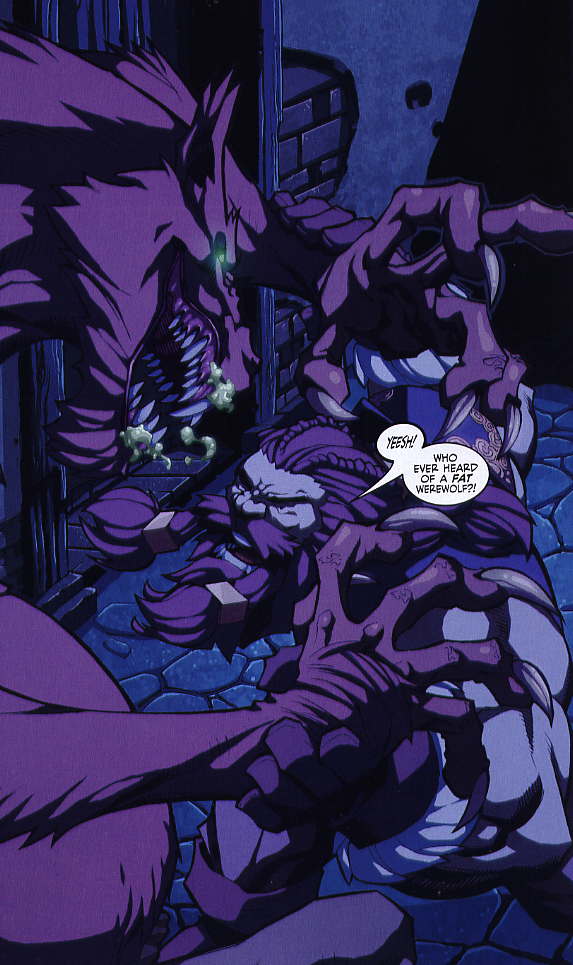
After a quick warm-up with a big fat werewolf, the boys stumble upon a potentially lucrative case - the assassination of a muckity-muck chancellor. Cable Guy spots a dark figure in a tower just before the chancellor takes an arrow in the face. Cable Guy chucks Dwarfpool into the top of the tower so they can cash in on the 1,000 opa reward.

The killer gets away after a some gum-flapping and monk-shotting, and now the chancellor's body has been carted away. The mercenaries negotiate a fee to retrieve the corpse, but by the last page Cable Guy & Dwarfpool may have bitten off more than they can chew.

This comic does have some things going for it. You don't need to read 53 other things to figure out what's going on, and you don't need to attend Dartmouth to follow the action. Speaking of action, there is plenty of it. The book is briskly paced, and while tastes vary I would say you're getting your $2.99 out of the comic.

But the Next Next Big Thing? No, not really. This is just Cable & Deadpool without Nicieza's wit or cutting social commentary. I thought the bit about the fat werewolf was mildly amusing, but most of Dwarfpool's jokes just don't land. Most of the humor consists of Dwarfpool being grumpy, which is fine I suppose, but not groundbreaking.

I found some of the dialogue jarring. Most of the time the characters talk in a kind of stilted, archaic pattern. Some of that works pretty well. Dwarfpool says "Don' worry, yer dignits. We'll catch the blooder!" I rather like that. Occasionally they break pattern and speak as though they just got done tweeting a post about Justin Bieber. Cable Guy advises Dwarfpool not to "go there", at one point.


It's not a deal breaker, and it's probably consistent with the tone of the book, which is entirely dedicated to fun. The comic does not take itself seriously, so I guess there's no reason to be slavish about diction. Your mileage may vary on that, but I wasn't in love with the speech anachronisms.

The only other item I found problematic was a blatant contradiction. The jerkwad law man forbids the mercs to chase the assassin on page 13... and then demands to know why Cable Guy isn't chasing him on page 17! Maybe the point was to demonstrate the fickle nature of the character. Maybe. I think it's more likely a screw up. Again, not the end of the world - but if the book can't keep that straight, how in the world can I really invest in it?

For all I know, this comic turns into a runaway freight train, and I wish it well. I wouldn't pay $15 for it, though, that's for sure. If your store sold out and you're interested, get with your comic shop and order the second print shipping in mid October. This is not a bad comic, per se. Matter of fact, I would guess that it hits my broadcast partner in a very cozy place and he happily adds it to his monthly pull. And lord knows I have shrugged my shoulders and watched feeding frenzies I didn't quite understand. Battle Chasers comes to mind. This could do very well indeed. But it's not for me.

So yeah. There's nothing particularly broken about Skullkickers, and I think I might feel better about it if it hadn't come with 160 metric tons of hype. It's a serviceable actioner with a lot of fun and energy behind it. But given the choice, I'd far prefer something like Red Robin. And comparing Skull Kickers to say....Morning Glories? To each her own, but that's like comparing fourth grade finger painting to a Rembrandt.

- Ryan